This page has moved to the Defense Innovation Unit
You are being redirected to DIU.mil
This page has moved to the Defense Innovation Unit
You are being redirected to DIU.mil
We use cookies for analytics, to see our policy, please read our Privacy Policy.
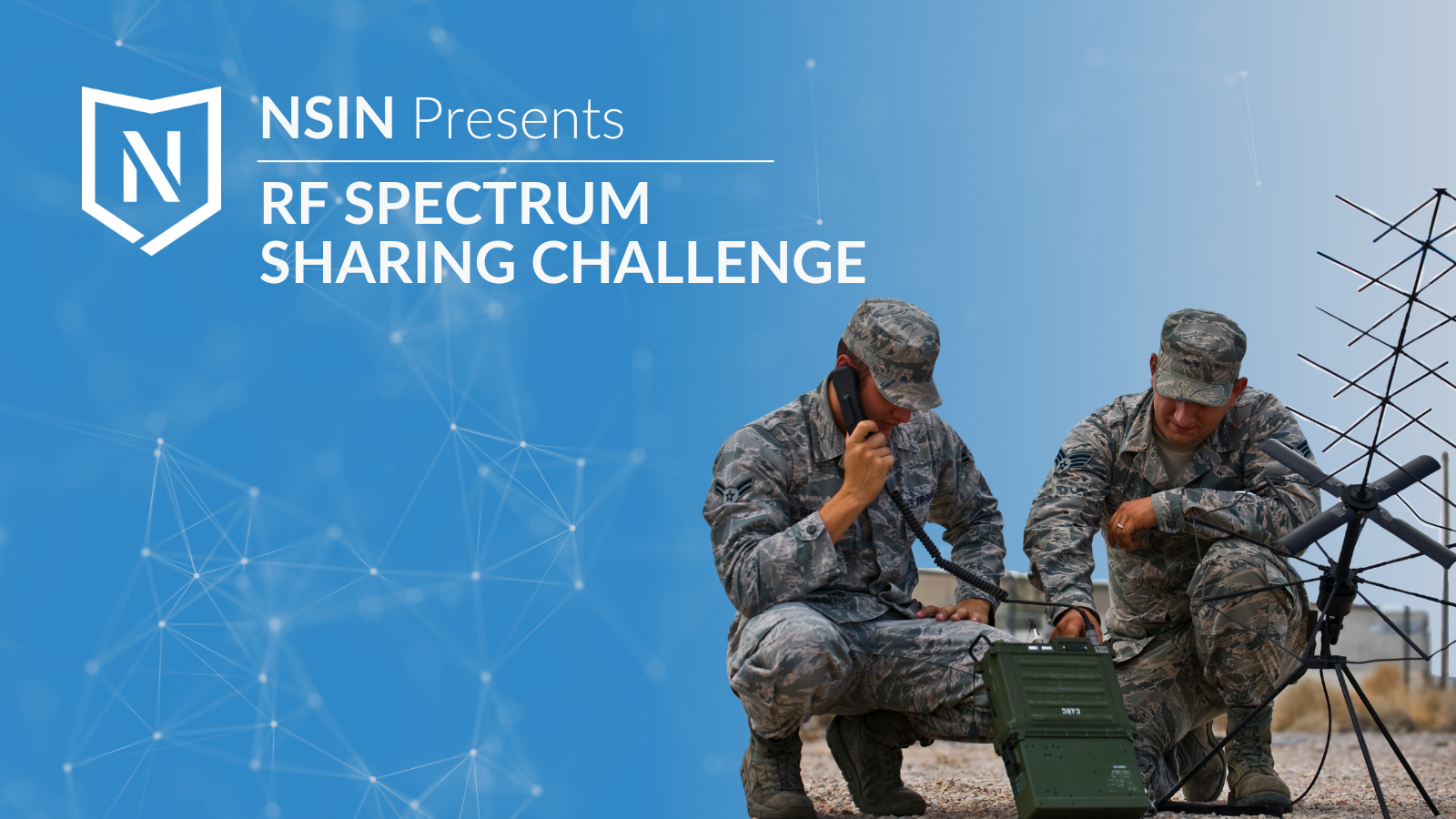
The National Security Innovation Network (NSIN), in partnership with the Air Force Research Lab (AFRL), will conduct a pitch event in December 2024 to identify capabilities in Artificial Intelligence (AI) and advanced signal processing technologies to enhance spectrum sensing and situational awareness for the United States Air Force (USAF) and United States Space Force (USSF).
Submissions will undergo evaluation by government subject matter experts (SMEs), with up to the top 15 qualified applicants selected to receive a portion of the $75,000 prize pot. Selected participants will advance to the second and third rounds, undergoing algorithm training and testing within a 45-day training period before receiving challenge data. This will be followed by four weeks of intensive testing. From these rounds, up to five finalists will emerge, progressing to the final round of the competition, all within the same timeline. The final stage will culminate in a hybrid pitch event during the week of January 27, 2025, where up to five finalists will present their solutions. Subject to availability of funds, the winner/winners from the pitch event may receive a prize of up to $50,000.
Spectrum congestion is a critical obstacle for both military and civilian operations due to restrictive static spectrum policies. Dynamic Spectrum Sharing offers a solution by managing conflicts through varying user access rights. Rapid and precise spectrum sensing is imperative. The RF Spectrum Sharing Challenge is a pivotal initiative, aimed at fostering innovation in automatic RF signal detection, characterization, and recognition. It accelerates advancements in machine learning and signal processing for RF signals, while facilitating the transition of top algorithms to vital DoD programs and stakeholders. The Spectrum Sharing Challenge addresses the complexities of Dynamic Spectrum Access (DSA), spectrum coexistence, and sharing, demanding a profound understanding of other spectrum users and precise waveform characterization to mitigate mutual RF spectrum interference effectively. In essence, this challenge serves as a catalyst for transformative advancements in spectrum management, shaping the future of military and civilian spectrum sharing by accelerating innovation in machine learning and signal processing for RF signals.
The Air Force Research Lab (AFRL) is launching the RF Spectrum Sharing Challenge, aimed at fostering innovation in spectrum management. This challenge focuses on the rapid and precise sensing of shared RF spectrum segments to optimize their utilization across diverse user categories. The spectrum-sharing regulations are forward-looking, encompassing emerging user types and a wide range of signal characteristics. Successful participants in this challenge will devise innovative techniques for detecting, recognizing, characterizing, and monitoring signals within the shared spectrum. The challenge welcomes various signal processing approaches, including spectrogram-based, cyclostationary signal processing, and IQ-based deep neural networks. Selected participants will have access to extensive simulated and/or captured over-the-air (OTA) data for the development, training, and testing of their solutions.
Round 1: Submission Period
Round 2: Algorithm Training
Round 3: Algorithm Testing 1
Round 4: Algorithm Testing 2
Round 5: Pitch Event
Participants must submit solutions for the RF Spectrum Sharing Challenge via the Ideascale link below.
Each phase will be evaluated based on the corresponding criteria outlined below.
Round 1 White Paper Submissions:
Round 2-4 Algorithm Training & Testing Submissions: Ability to Transmit Metric
Round 5 Pitch Event: This is a full day event, with a private government meeting with each individual finalist team/company in the first half of the day, followed by the pitches in the afternoon. The pitch format will be public and include a 5-minute presentation followed by 5 minutes for questions and answers from the judging panel.
For technical details, refer to the RFSSC Participant Guide.
1) Possess suitable computational resources to process RF scenes, which comprise 10-second I/Q data files sampled at 50 MHz.
2) Each RF scene file will be associated with a particular instantiation of the RFSSC spectrum-sharing parameters, which in part specifies how the time-frequency plan (10 seconds by 50 MHz) is broken into small time-frequency cells. These cells then define a gridding of the plane so that it can be represented by a matrix. For example, the frequency axis might be broken into segments with length 1 kHz and the time axis might be broken into segments with length 1 ms. Then the matrices defined in the following items would have dimension (10000 x 50000).
3) Provide, for each supplied RF scene file, Ability-to-Transmit matrices for primary and secondary user classes.
4) Provide, for each supplied RF scene file, Spectral Occupancy (SO) matrices, which are binary-valued matrices. A matrix entry equal to one means that that time-frequency cell is occupied (signal plus noise), a value of zero means it is not occupied (noise only).
Round 1 Submission Deliverable: Participants must submit the following by 23:59 Eastern Time on the designated submission day:
Round 2-4 Deliverable: Excel spreadsheet with result, format TBD
Round 5 Pitch Event Deliverable: Finalists will deliver pitch presentations by 23:59 Eastern Time on the designated submission day. The pitch format will include a 5-minute public presentation followed by 5 minutes for questions and answers from the judging panel.
About National Security Innovation Network
NSIN is a program office in the U.S. Department of Defense (DoD), nested within the Defense Innovation Unit (DIU). We are set up to collaborate with a wide variety of innovators to include universities, researchers, students, entrepreneurs and start-ups. We create opportunities for collaboration across communities and connect those that might not traditionally work in national security. Together, we help drive national security innovation and develop technologies that directly support the individuals responsible for protecting our country.
For more information or interview requests with Team NSIN, please contact us at media@nsin.mil.
About Air Force Research Laboratory
AFRL is the primary scientific research and development center for the Department of the Air Force. AFRL plays an integral role in leading the discovery, development, and integration of affordable warfighting technologies for our air, space, and cyberspace force. With a workforce of more than 12,500 across nine technology areas and 40 other operations across the globe, AFRL provides a diverse portfolio of science and technology ranging from fundamental to advanced research and technology development.
Your browser is old and unsupported. You may still use the site, but functionality will be limited and you may see errors. Please consider updating your browser.